What an ETF actually is
You cannot buy the S&P 500. It is a scoreboard, not a thing. An ETF is the object you can actually own, and the gap between the two explains a lot of small surprises.
Anyone who has just worked out what the S&P 500 is tends to ask the same question next. How do I buy it? The honest answer is that you cannot, because the S&P 500 is a list and a number, and there is no way to purchase a number. What you can buy is a fund that promises to hold those same companies in roughly the same proportions. That fund is a separate object with its own manager, its own costs and its own small imperfections, and knowing the difference is the difference between understanding what you own and guessing.
An index is a scoreboard
An index is a measurement, and nothing more. Somebody chooses a list of companies, decides how much weight each one carries, and publishes a single number summarising how that list has done. The S&P 500 is a list of roughly five hundred large American companies maintained by a committee, and we wrote about who those people are in What the S&P 500 actually is.
The useful comparison is a football league table. The table tells you precisely how every club is performing, and it is genuinely informative, but it is a description of the season rather than a part of it. You cannot buy the table. An index sits in exactly that position: it reports on the companies without ever holding any of them.
A fund is a thing you can hold
An ETF, which stands for exchange traded fund, is a real fund with a manager, a bank account and a portfolio of actual shares. When you buy a unit of an S&P 500 ETF, you are buying a small slice of that portfolio. The manager's job is to hold the underlying companies in close to the right proportions, so that the value of the fund moves almost exactly as the index does.
The second half of the name matters more than it looks. The fund trades on an exchange, like an ordinary share, so you can buy or sell it through the day at whatever price it is changing hands for. That sounds obvious now, but it was the innovation. The older way to own a basket of shares was a mutual fund, which you could only buy or sell once a day at a price calculated after the market had closed.
Where the two quietly drift apart
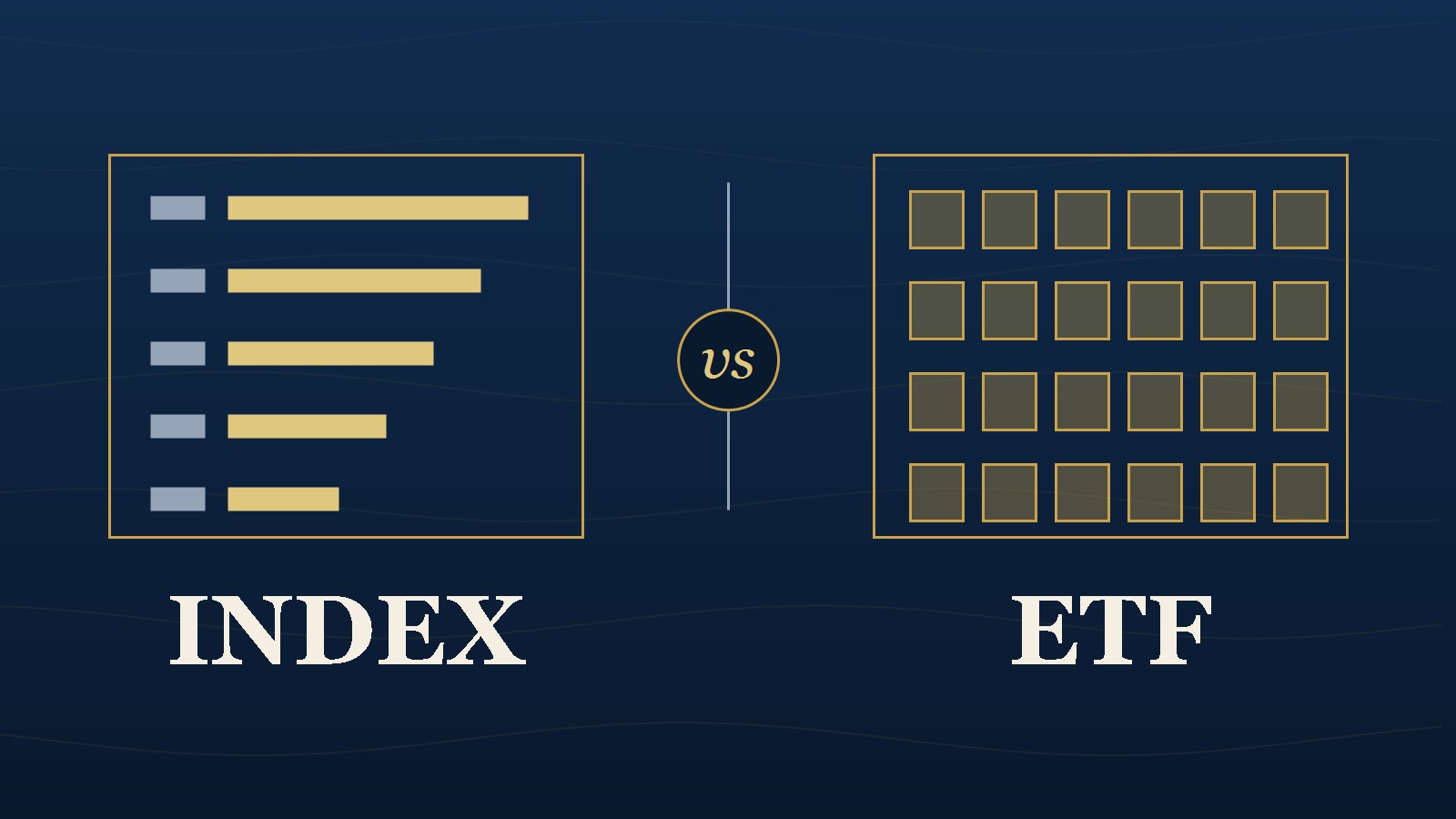
Because the index and the fund are different objects, they never track each other perfectly, and the small gaps between them are worth knowing about.
The first is cost. A fund charges an annual fee, usually quoted as a percentage, and it comes out of your returns whether the fund rises or falls. On a broad index fund this is often very small, but it is never nothing, and it compounds in the same quiet way returns do.
The second is the mechanics of tracking. A manager holding five hundred companies has to buy and sell as the list changes and as money flows in and out, and each of those trades costs something. The result is a small annual difference between the index and the fund, which the industry calls tracking difference, and it is almost always a slight drag rather than a bonus.
The third is price. An index has one value at any moment. An ETF has a market price set by whoever is buying and selling it, and that price can sit slightly above or below the value of the shares the fund actually holds. Large, heavily traded funds keep this gap tiny. Small or unusual ones do not always manage it.
What you own, and what you do not
This is the part that surprises people. You do not own the underlying companies. You own units in a fund, and the fund owns the shares. If you hold an S&P 500 ETF you are not a shareholder of those five hundred businesses, and the voting rights that come with those shares belong to the fund manager rather than to you.
For most people this changes nothing practical, since the returns still reach you and the dividends are either paid out or reinvested depending on the fund. It is simply worth being accurate about what sits in your account. You own a claim on a portfolio, not a piece of every company in it.
The takeaway
None of this is an argument against index funds, which are a sensible and inexpensive way for most people to own a slice of the market. It is an argument for precision. The index is the measurement, the ETF is the product, and the product carries a fee, a manager and a market price that the measurement does not have. When somebody says they own the S&P 500, what they really own is a fund that does its best to look like it. That is a good deal. It is just not the same sentence.
This article is educational and reflects the views of the Wealth Stratum community. It explains how a common investment product works, in general terms, and is not financial advice or a recommendation to buy or sell any security. Always do your own research.