The month a group chat took on Wall Street
In January 2021 a dying video game shop became the most traded stock on earth, because strangers on the internet noticed that more of its shares had been sold short than actually existed. What happened next is still argued about.
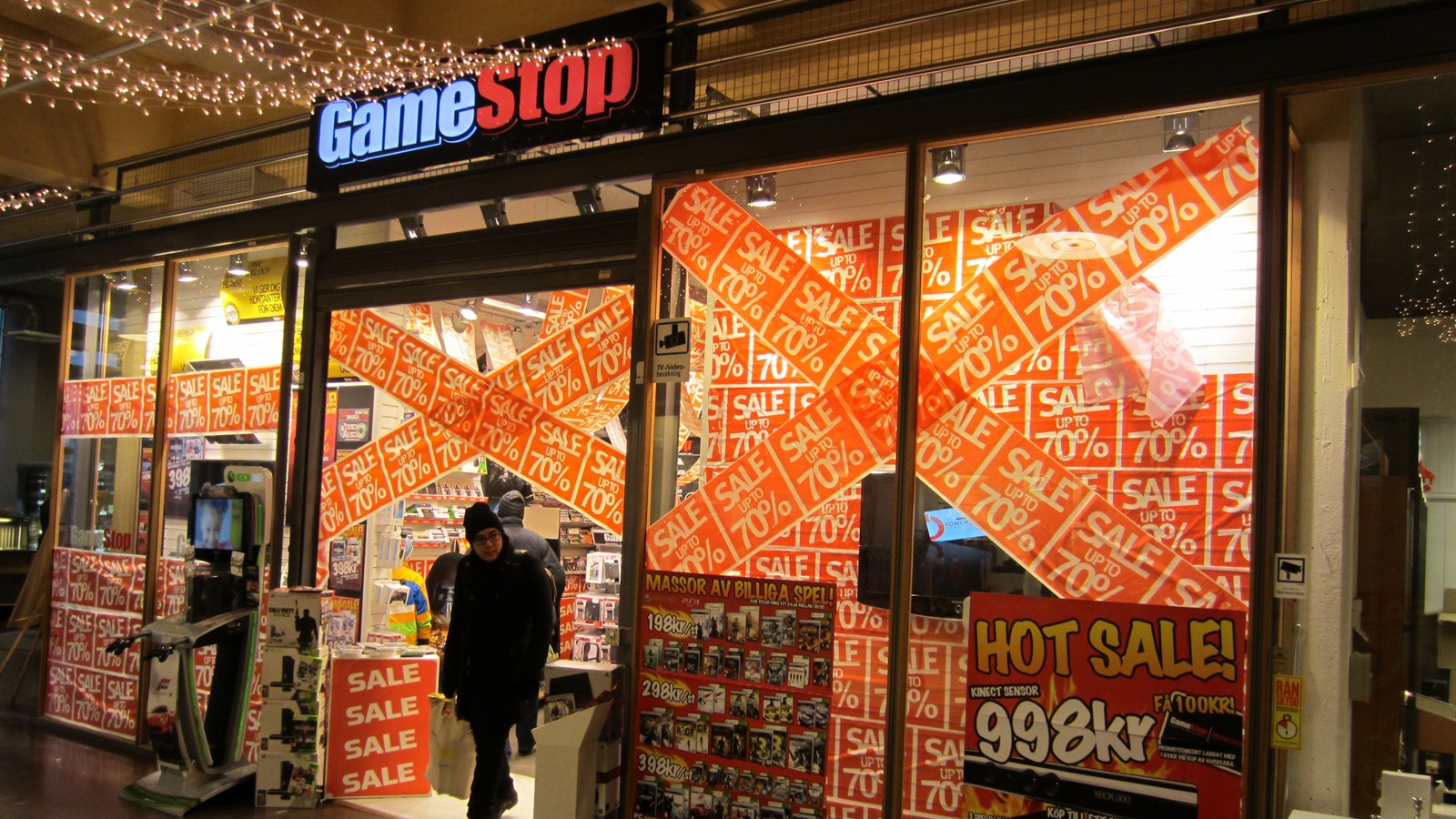
GameStop sold video games out of shopping centres, which was a fine business in 2007 and a difficult one by 2020, because people had started downloading games instead of driving to buy them. The shares traded around twenty dollars at the start of January 2021. Three weeks later they touched four hundred and eighty three, the company was briefly the most traded stock on the planet, and a hedge fund that had bet against it had lost more than half its money. The people who did it were not professionals. They were strangers in a forum, and what they had spotted was a number that most investors never think to look at.
Selling something you do not own
To understand the month you need one idea, and it is a strange one the first time you meet it. You can sell a share you do not own. It is called short selling, and the way it works is that you borrow the share from somebody who does own it, sell it immediately, and promise to buy it back later and return it. If the price falls in between, you keep the difference. It is the ordinary bet on a stock, run backwards.
The risk is not symmetrical, and this is the part that matters. If you buy a share at twenty dollars, the very worst outcome is that it goes to zero and you lose twenty. If you short a share at twenty dollars, there is no ceiling on what you might have to pay to buy it back. Your possible loss is unlimited, and it is exactly the position described in How to lose more than you put in.
Put numbers on it and the asymmetry stops being abstract. Short a share at twenty dollars and you receive twenty dollars today. If it falls to five, you buy it back for five and keep fifteen, which is the best case and it is capped. If it climbs to four hundred, you still have to produce a share, and buying one now costs four hundred. You are down three hundred and eighty on a bet that could only ever have made you twenty. Nothing about that changes if you were right about the company.
The number that started it
By 22 January 2021, roughly 140% of GameStop's freely traded shares had been sold short. That figure sounds impossible, and people reasonably assume it is a misprint. It is not.
It happens because a borrowed share can be borrowed again. A short seller borrows a share and sells it. Whoever buys it now owns it, and can lend it out to a second short seller, who sells it too. The same underlying share is now behind two separate short positions, and the count can rise above the number of shares in existence. Analysts at Goldman Sachs later noted that short interest above 100% of a company's freely traded shares had happened only fifteen times in the previous decade.
Members of a forum called r/wallstreetbets worked out what that meant. If the price rose, every one of those short sellers would eventually need to buy the share back, and there were not enough shares to go round. Buying to close a losing short pushes the price up, which hurts the next short seller, who then also has to buy. That self feeding loop is called a short squeeze.
Three weeks
They bought, and they told each other they were buying, and the price went up. It kept going up through the middle of January in a way that stopped resembling anything a business could justify, because by then the price had very little to do with the shops.
Melvin Capital, a hedge fund with a large short position against GameStop, closed that position on 26 January. It finished the month down 53%, a loss of around 6.8 billion dollars, and had to take an emergency injection of 2.75 billion dollars from Citadel and Point72 to keep going. On 28 January the shares touched 483 dollars during the day.
That same morning, Robinhood and several other brokers restricted buying in GameStop. Users could sell but not buy, which looked to a great many people like the game being stopped the moment ordinary people were winning it. The explanation was duller and is worth knowing, because it is a real feature of how markets work. Trades take time to settle, and while they settle, a broker has to post a deposit with the central clearing house. The clearing house demanded roughly ten times the usual amount that week, and Robinhood did not have it on hand.
What actually happened, according to the regulator
Here is where the popular story and the evidence separate.
Everyone remembers January 2021 as the short squeeze. In October 2021, the Securities and Exchange Commission published its own staff report on the episode, and its finding was not that. The staff concluded that buying by short sellers closing their positions was a small fraction of total buying volume, and that the price stayed high long after the effects of that covering should have faded. Their words were that it was positive sentiment, rather than the buying to cover, that sustained the rise.
In other words, the regulator's reading is that the squeeze was real but was not the engine. What kept the price up was an enormous number of people simply deciding to buy and to keep holding.
That conclusion is itself contested. A group of academics published a detailed critique of the report, arguing that the staff had underrated the role of short covering and of options trading. So the honest position is that the most famous market event of the decade does not have an agreed explanation, which is a more interesting thing to know than a tidy one.

What it actually teaches
Not that a forum can beat Wall Street. Most of the people who bought GameStop late did not make money, and a great many bought near the top and watched it fall for months. The winners were mostly early, and being early is not a strategy anyone can repeat on purpose.
The aftermath was quieter than the month itself. The price came down a very long way from four hundred and eighty three, and congressional hearings followed in February. The argument about what had actually happened moved from the forum to the regulators, and then into academic journals, where it still sits. The shops carried on selling video games.
The durable lessons are smaller and more useful. Short selling carries a loss with no ceiling, which is why a crowded short position is dangerous for the people holding it. Prices are set by buyers and sellers rather than by what a business is worth, and for several weeks GameStop proved that in the most vivid way available. And the plumbing of the market, the settlement periods and clearing deposits nobody thinks about, can reach up and change what you are allowed to do with your own money on a given morning.
There is one more, which is the one we keep returning to. The version of this story that everybody repeats, the clean tale of a squeeze that retail investors engineered against the professionals, is not what the official investigation found. It is not that the popular story is a lie. It is that it hardened into fact long before anyone finished checking, which is what usually happens to a good story about markets.
This article is educational and reflects the views of the Wealth Stratum community. It describes historical events and general market mechanics, and is not financial advice or a recommendation to buy or sell any security. Always do your own research.