The crash that lasted 36 minutes
Close to a trillion dollars left the American stock market and came back before lunch. Five years later police arrested a man who had been trading from his parents' house in west London.
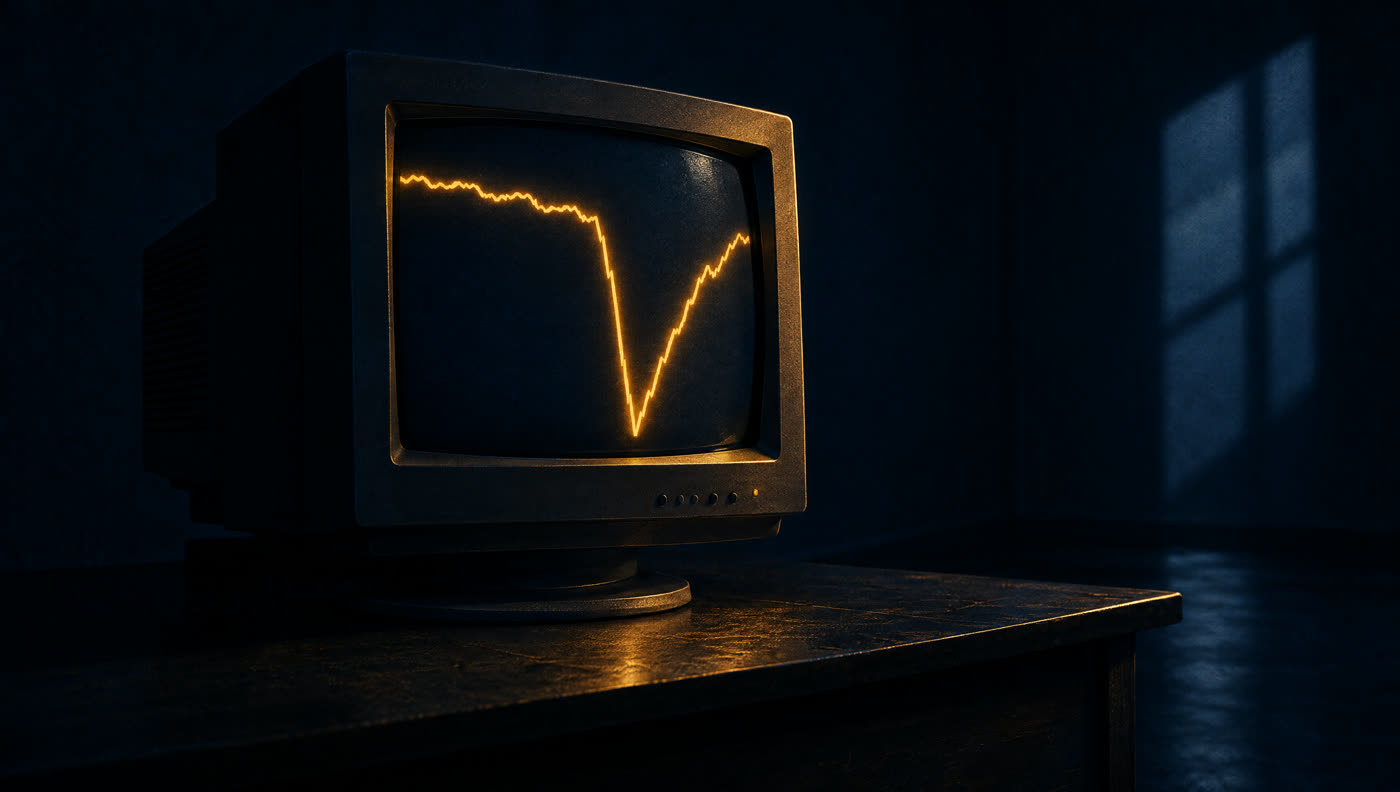
At about half past two on the afternoon of 6 May 2010, the American stock market stopped behaving like a market. Prices did not drift downward the way they do in a bad week. They fell off a cliff. The Dow Jones Industrial Average dropped roughly nine per cent in a matter of minutes, the steepest intraday fall it had ever recorded, and traders watching their screens genuinely could not tell whether the numbers in front of them were real. Then, before most people in the building had finished reacting, it came back. The whole episode lasted about thirty six minutes.
The afternoon nothing made sense
What made the day frightening was not the size of the fall on its own. Markets have fallen further. It was that the prices stopped meaning anything at all.
Shares in Accenture, a consulting firm worth tens of billions of dollars, briefly changed hands at one cent. At the other extreme, some shares traded at absurdly high prices for no reason anybody could explain. These were not typing errors by panicking humans. They were the natural consequence of a market in which almost all of the buying and selling is done by machines, and the machines had quietly stepped back.
That is the detail worth holding on to. A share price is not a fact about a company. It is simply the price at which somebody was willing to trade, and if the willing buyers disappear for ninety seconds, the price can go anywhere. On a normal day you never notice, because there is always someone there. On this afternoon there briefly was not.
Who does the buying when nobody is buying
Modern markets rely on firms called market makers, whose business is to stand ready to buy from anyone selling and sell to anyone buying, taking a sliver of the difference. They are the reason your order fills instantly. They are also, crucially, not obliged to be there.
It is worth understanding why they are not obliged. In the old days of the trading floor, certain firms had a formal duty to keep quoting prices in the shares they were assigned, in return for privileges. Electronic trading dissolved most of that arrangement. The firms that replaced them are faster, cheaper and better for ordinary investors on almost every normal day, and they operate under no comparable obligation to stay in the market when it turns ugly.
That trade was made deliberately, and for most purposes it was a good one. The cost only appears on days like this one.
When the falls began, many of those firms did what any sensible business would do when it cannot tell what is happening. They widened their prices or withdrew altogether, because continuing to buy into a collapse you do not understand is a very fast way to lose a great deal of money. Their caution was individually rational and collectively catastrophic. The moment they stepped back, the cushion under the market went with them.
The official explanation, and the one everybody remembers
Regulators spent months on it. The report that followed pointed at a very large automated sell order in stock market futures, placed by a fund manager and set to execute at a pace tied to trading volume rather than to price. As the selling pushed prices down, volume rose, and the higher volume told the program to sell faster. It had no instruction to stop and look around.
That is a mundane, plausible cause: a badly designed instruction meeting a market with thinning support. It is also not the version most people know.
In 2015, police in London arrested Navinder Singh Sarao, a self-taught trader who worked from his parents' semi-detached house in Hounslow, under the flight path near Heathrow. Prosecutors said he had spent years placing enormous orders he never intended to complete, a practice known as spoofing, in order to nudge prices in his favour. He later pleaded guilty. The story was irresistible, and the headlines wrote themselves: one man in a suburban bedroom broke Wall Street.
What is actually agreed, and what is not
It is worth being careful here, because this is where most retellings go wrong.
That Sarao spoofed the market is settled. He admitted it. That his activity on that particular afternoon was the cause of the flash crash is genuinely disputed, and always has been. He had been trading in a similar way on many other days that did not produce a crash, and the regulators' own account gave a large role to the fund manager's sell program and to the market makers withdrawing. Serious people still disagree about how the blame divides.
When he was finally sentenced in 2020, he received a year of home detention rather than prison. Whatever else that tells you, it does not suggest a court convinced it was punishing the man who single-handedly erased a trillion dollars.
The trades they had to cancel
There is a postscript that says more about the day than any of the arguing over blame. Once the dust settled, the exchanges concluded that a large number of the trades that had taken place were so far from any sensible price that they could not be allowed to stand. Thousands of them were simply cancelled.
Sit with that for a moment. A trade is supposed to be final. Somebody sold, somebody bought, and the ordinary rule is that you live with the price you got. On this afternoon the authorities decided that a portion of those transactions had not been a market at all, and unwound them.
That was the right call, and it was also an admission. If a price can be voided afterwards for being absurd, then the number on the screen during those minutes was not really a price. It was a placeholder produced by machines trading with each other in the absence of anybody willing to say what the shares were worth.
The people who did worst were not the ones whose trades were cancelled. They were the ones whose losses landed just inside the threshold, close enough to the old price to count as real. Their sales stood.
Why it still matters
The comforting reading of the flash crash is that it was a freak accident, patched and forgotten. Exchanges did introduce circuit breakers afterwards, which pause trading in a share that moves too violently too quickly, and those have prevented repeats of exactly this shape.
The uncomfortable reading is more useful. The market that fell apart that afternoon is the same market you buy shares in today, only faster and more automated. Its stability rests on a large number of independent firms all choosing to keep trading at the same moment, and none of them has promised to do so.
You will probably never be affected by a thirty six minute crash. You will be affected by the assumption underneath it, which is that there is always someone on the other side of your trade at a sensible price. Almost always, there is. The flash crash is the afternoon that showed what happens in the gap between almost always and always.
This article is educational and reflects the views of the Wealth Stratum community. It explains a general investing concept in plain terms and is not financial advice or a recommendation to buy or sell any security. Always do your own research.